

October 15, 2026
•
16 minute read
Best Bike Workshop Software for Franchise Groups
This article compares six platforms used by bike workshops and retailers, with clear decision criteria around multi-location control, service workflows, and operational fit for franchise-style groups.

Ryan Elson
Founder & CMO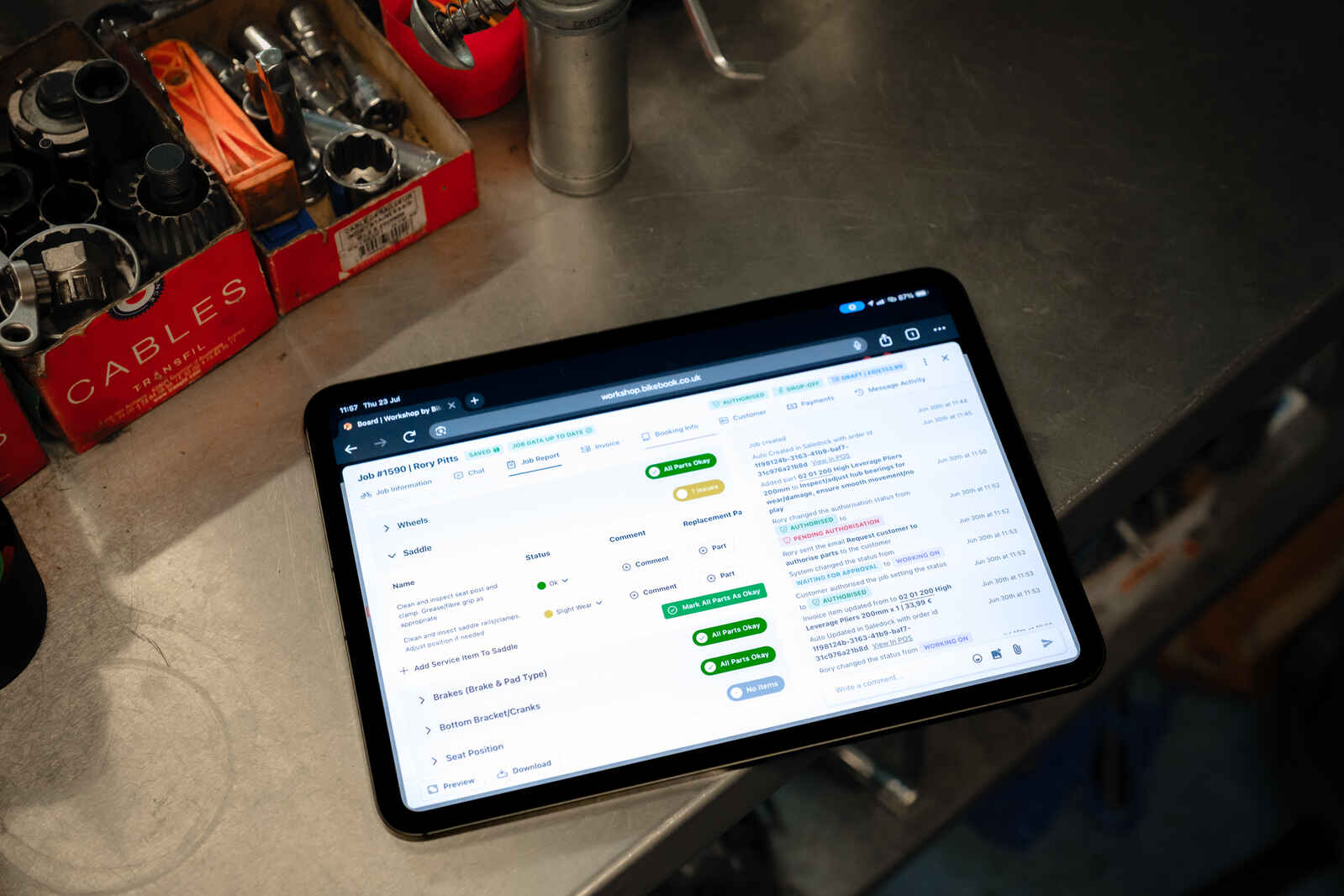
Running a group of bike workshops across multiple locations means juggling separate calendars, inconsistent job workflows, and stock levels that never quite match. When one branch runs out of brake pads mid-service and another has a shelf full, that is not a problem you can fix with a spreadsheet.
Bike workshop management software built for the cycling trade gives franchise and group operators the operational control they actually need.
Workshop by Bikebook connects bookings, digital job cards, customer updates, stock, invoices, and reporting across every location from one platform. For group operators comparing options, the differences between workshop-first tools and general retail systems matter more than feature lists alone.
This article compares six platforms used by bike workshops and retailers, with clear decision criteria around multi-location control, service workflows, and operational fit for franchise-style groups.
Quick guide: 6 best bike workshop software for franchise groups
- Workshop by Bikebook: The best workshop management platform for franchise and multi-location bike service operations
- Lightspeed Retail: Retail POS with vendor catalogues and service order tracking for bike shops focused on ecommerce
- Hubtiger: Online booking and repair workflow tool used by bike and repair shops
- Citrus-Lime: Cycle-specific EPOS with a built-in workshop calendar and supplier integrations
- Ascend RMS: Bike retail management system with work orders and multi-store transfer capability
- Bikedesk: Bike shop POS covering sales, repairs, and online booking from a single interface
How we chose the best bike workshop software for franchise groups
Choosing software for a single workshop is one thing. Choosing it for three, five, or ten locations is a different conversation entirely. We looked at platforms used across the cycling trade and evaluated each one against the operational realities of running a group.
- Multi-location visibility: Can you see job progress, booking capacity, and stock levels across every branch from one login? Group operators need a single view of the whole operation, not a separate dashboard per shop.
- Workshop-first workflows: Does the platform treat service as the core of your business, or is the workshop module an afterthought bolted onto a retail POS? This shapes everything from how bookings are managed to how mechanics interact with the system daily.
- Standardised job processes: Can you define your own statuses, service menus, and approval steps so every branch follows the same process? Consistency across locations reduces errors and makes reporting meaningful.
- Integration depth: Does it connect to the tools you already use, including POS, ecommerce, accounting, payment providers, and cycling-specific suppliers? A platform that sits apart from your existing stack creates duplicate data entry.
- Customer communication: Does the system send automated updates to customers at each stage of the repair, so your team spends less time on the phone and more time on the stand?
- Reporting and performance tracking: Can you compare mechanic productivity, turnaround times, and revenue across branches without exporting to spreadsheets?
The 6 best bike workshop software for franchise groups
1. Workshop by Bikebook: Best overall bike workshop software for franchise groups
Workshop by Bikebook was built on a bike workshop floor, developed in collaboration with Cytech-registered mechanics who understand what a busy Tuesday morning actually looks like. For franchise and group operators, that trade-specific foundation matters. Every feature is designed around service workflows, not adapted from a generic retail system.
The platform gives you a single view across all your locations. You can see which branches have capacity, which jobs are waiting for parts approval, and which mechanics are on the stand, all from one login. Standardised job statuses, service menus, and approval steps mean your team in Brighton follows the same process as your team in Bristol.
Workshop by Bikebook connects to cycling-specific supplier catalogues including Upgrade Bikes, so your mechanics can check live stock and raise back orders straight from the Job Card. Automated SMS and email updates keep customers informed at every stage without your front desk picking up the phone.
The platform is designed to boost customer retention by up to 22% and can save a mechanic up to 10 to 15 minutes on a major service.
Workshop by Bikebook features
- Multi-location Board View: See job progress, booking capacity, and mechanic workload across every branch from a centralised dashboard, so you always know where capacity sits.
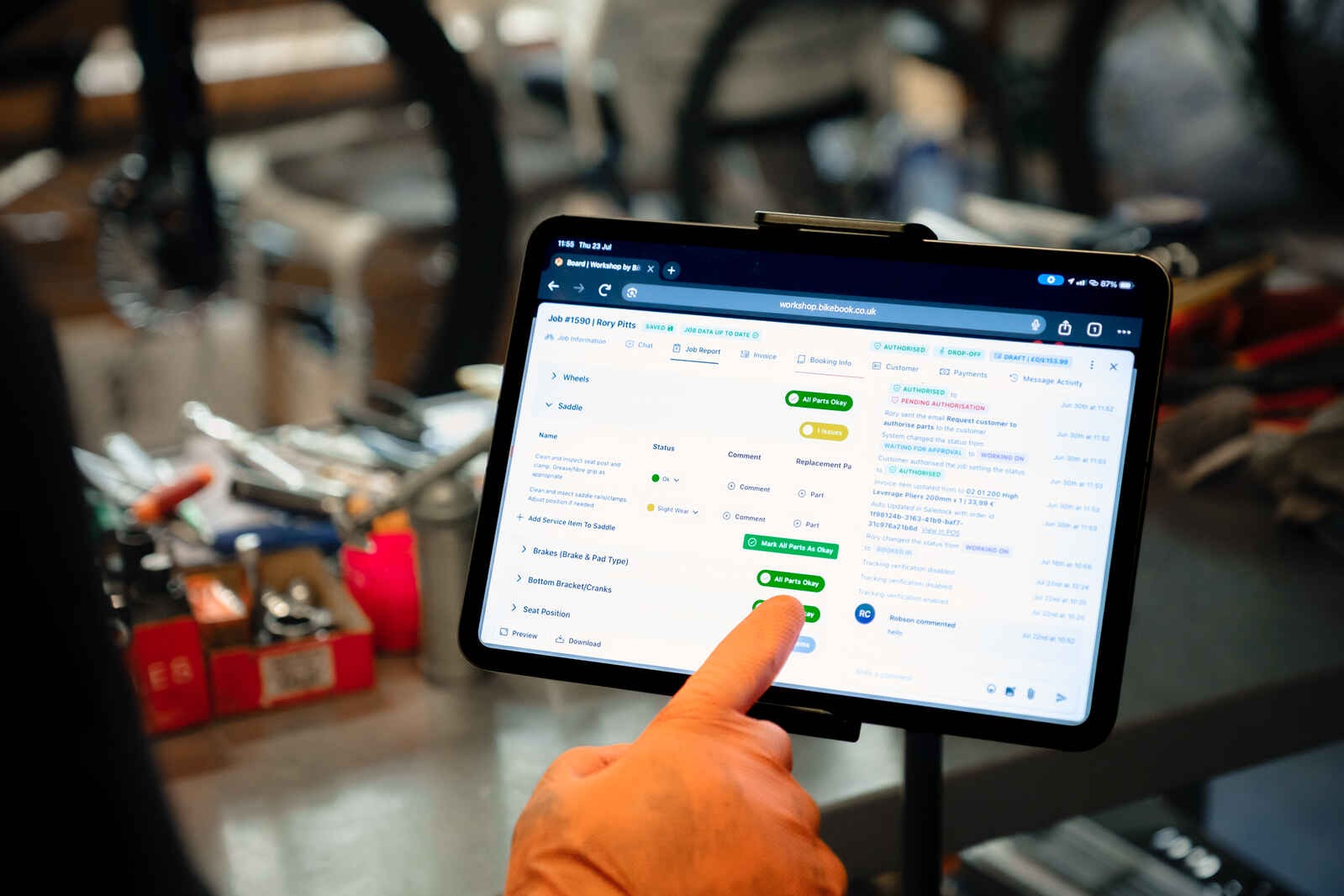
- Digital Job Cards with photo documentation: Every repair gets a complete digital record with photos, notes, and service history attached, giving your team and your customers full transparency.
- Automated customer updates: SMS and email notifications send themselves as a job moves through your custom statuses, which means fewer phone calls and more time on the stand.
- Live supplier stocklists: Connected to 13 suppliers, Workshop by Bikebook lets mechanics check parts availability and raise orders without leaving the Job Card.
- One-tap approvals for extra work: Find a worn chain mid-service? Send the customer a photo and a price. They approve in one tap, and you keep working.
- Integrated payments and accounting: Deposits at booking, card payments via Stripe, Zettle, SumUp, or Square, and invoices synced straight to Xero so every payment reconciles to its job.
Workshop by Bikebook pros and cons
Pros:
- Workshop-first design built specifically for the cycling industry, not retrofitted from a retail POS
- Multi-location visibility with standardised workflows, permissions, and reporting across branches
- Deep integration with cycling-specific suppliers, POS platforms like Lightspeed and Shopify, and accounting tools
Cons:
- The platform focuses on service operations, so shops that need a full retail POS will pair it with an existing system rather than replacing one
- Setup for multi-location groups involves configuring service menus, statuses, and integrations per branch, which takes dedicated onboarding time
- Some advanced reporting features are available on higher-tier plans
2. Lightspeed Retail: Retail POS with service orders for bike shops with ecommerce needs
Lightspeed Retail is a cloud-based POS system used by many bike retailers, particularly in North America. The platform offers inventory management with vendor catalogue integrations from cycling distributors, alongside an ecommerce module that syncs products across online and in-store channels.
For workshop operations, Lightspeed includes a service orders module within the POS. You can create repair tickets, track job progress, and assign work to mechanics. Multi-location support is available, with inter-store inventory visibility and the ability to transfer stock between branches.
Lightspeed Retail features
- Vendor catalogue integrations: Integrated ordering from cycling-specific suppliers with purchase order management and stock-level syncing.
- Multi-location inventory: View stock across branches, process inter-store transfers, and manage serialised inventory for individual bikes and frames.
- Ecommerce module: Sell online, on social media, and on marketplaces with inventory synced to your physical locations.
Lightspeed Retail pros and cons
Pros:
- Established vendor catalogue connections with major cycling distributors
- Multi-location inventory management with inter-store transfer capability
- Integrated ecommerce for shops selling online alongside in-store
Cons:
- Workshop functionality is a module within a retail POS rather than a standalone service workflow platform
- Customer-facing online booking for repairs is not a built-in feature of the core POS
- The platform is built for general retail, so cycling-specific service workflows require additional configuration
3. Hubtiger: Online booking and repair workflow tool for bike shops
Hubtiger offers repair management software with online booking, digital work orders, and automated customer communication. The platform is used by bike shops alongside other repair verticals, with integrations to existing POS systems. Hubtiger reports managing over 4.4 million repair jobs across more than 2,000 shops.
The system includes a customer-facing booking widget, job status tracking, and notification delivery via email, SMS, or WhatsApp. Repair quotes and invoices can be generated from within work orders with parts and labour pricing pulled from connected POS data.
Hubtiger features
- Online repair scheduling: Customers book repairs through a widget on your website, and details land in your workshop calendar.
- Automated notifications: Updates sent at each repair stage via email, SMS, or WhatsApp, with customisable triggers.
- Productivity tracking: Log time against repairs to compare estimates with actual work and track mechanic output.
Hubtiger pros and cons
Pros:
- Customer-facing online booking widget that can be embedded on your website
- Notification options include WhatsApp alongside SMS and email
- Works across repair verticals, not limited to cycling
Cons:
- Multi-location management for franchise groups is not the platform's primary focus
- Relies on integration with a separate POS for retail and inventory functions
- Cycling-specific supplier connections and parts catalogues are not available natively
4. Citrus-Lime: Cycle-specific EPOS with workshop scheduling and supplier integrations
Citrus-Lime provides an EPOS system designed for independent cycle retailers in the UK. The platform combines point-of-sale, stock control, ecommerce, and a workshop scheduling module in one system. Citrus-Lime reports being used by over 400 UK bike shops, including multi-store retailers.
The workshop module includes a calendar-based booking system, job status tracking, and parts logging against repair jobs. Because the workshop sits inside the EPOS, parts used in service are reflected in stock levels immediately, and completed jobs can be invoiced without manual re-entry.
Citrus-Lime features
- Integrated workshop calendar: Book jobs, track mechanic availability, and manage turnaround times within the EPOS.
- Supplier integration module: View live stock availability and place special orders from connected cycling distributors.
- Click and collect ecommerce: Sell online with product feeds uploaded automatically from your inventory.
Citrus-Lime pros and cons
Pros:
- Workshop scheduling is natively built into the EPOS rather than requiring a third-party integration
- Parts logged against workshop jobs update stock levels in real time
- Supplier integrations with cycling-specific distributors are included
Cons:
- The platform is primarily focused on UK-based cycle retailers
- Automated customer communication during repairs is not as prominent as dedicated workshop tools
- Workshop functionality is part of the broader retail system, not a standalone service-first platform
5. Ascend RMS: Bike retail management with work orders and multi-store support
Ascend RMS is a retail management system built for bike shops, used widely by Trek dealers and independent outdoor retailers in North America. The platform covers POS, inventory management, work orders, a multi-point inspection form, and multi-store capabilities including product transfers between locations.
For service operations, Ascend includes a work order module with technician scheduling and availability tools. Vendor catalogue integrations and cloud-based data sharing allow multi-location groups to maintain consistent product information and pricing across their branches and departments.
Ascend RMS features
- Multi-store transfers: Move inventory between locations and view stock levels across all branches.
- Work order management: Create, assign, and track service work orders with a built-in multi-point inspection form.
- Vendor catalogue integrations: Import product data from cycling suppliers with automated catalogue syncing.
Ascend RMS pros and cons
Pros:
- Multi-store inventory and transfer features are built into the system
- Work orders include a multi-point inspection form for standardised service checks
- Vendor catalogue data sharing reduces manual product entry across locations
Cons:
- The platform's service module does not include customer-facing online booking
- Workshop workflows sit within a retail-first management system rather than a dedicated service platform
- Automated customer communication during repairs is limited compared to workshop-specific tools
6. Bikedesk: Bike shop POS with repairs, online booking, and service reminders
Bikedesk is a POS system designed for bike shops, originating in Denmark and now used in the UK and across Europe. The platform covers sales, inventory management, repair work orders, customer communication, and online booking. Bikedesk includes automated SMS and email updates during the repair process, along with service reminders for follow-up work.
The system integrates with webshop platforms for synchronised inventory and connects to payment solutions for in-store checkout. Bikedesk focuses on independent bike retailers and offers features aimed at reducing admin time through automation of the repair-to-pickup workflow.
Bikedesk features
- Automated repair updates: Send SMS and email updates to customers at each stage of the repair process.
- Online booking: Customers can book repairs through your website without phone calls.
- Service reminders: Automated follow-up notifications remind customers when their next service is due.
Bikedesk pros and cons
Pros:
- Automated repair communications and service reminders are included in the platform
- Online booking reduces admin time spent on phone-based scheduling
- Webshop integration keeps online and in-store inventory synchronised
Cons:
- Multi-location management features for franchise or group operators are not prominently available
- The platform is primarily established in the Nordic and European market
- Cycling-specific supplier catalogue integrations are more limited than retail-focused competitors
What should franchise bike workshop groups look for in management software?
Franchise and multi-location bike workshop groups need software that balances standardisation with local flexibility. Every branch should follow the same service process, from how a job is booked in to how the customer is updated, but individual locations still need control over their own schedules, stock, and mechanic assignments.
The most important capability is a unified view of operations. You should be able to see job volumes, booking capacity, and outstanding approvals across all locations without logging into separate systems. Workshop by Bikebook provides this through its multi-location Board View, giving operations managers real-time visibility into each branch.
Integration depth also matters. A platform that connects your workshop to your POS, accounting, payments, and suppliers removes duplicate data entry. For cycling businesses specifically, connections to trade suppliers and tools like Xero or Shopify make the daily workflow faster and less error-prone.
How does workshop-first software differ from a retail POS with a service module?
A retail POS with a workshop add-on treats service as a secondary function. The system is designed around selling products at a till, and the repair workflow is adapted to fit within that retail framework. This can mean limited job status customisation, no customer-facing online booking, and parts management that does not reflect how a workshop actually consumes stock.
Workshop-first software like Workshop by Bikebook starts with the service operation. The entire platform is structured around how a job moves from booking to the stand to collection, with automated customer updates, photo-based approval workflows, and live supplier connections built into the Job Card itself.
For franchise groups, this distinction is significant. Workshop-first design means your mechanics interact with a system that mirrors their actual workflow, which reduces resistance to adoption and speeds up onboarding across new branches. According to a PERC Engage guide on multi-location systems integration, businesses with standardised processes across sites experience significantly fewer scheduling conflicts and lower administrative costs.
Why Workshop by Bikebook is the best bike workshop software for franchise groups
Workshop by Bikebook gives franchise and group operators something that general retail systems do not: a platform where the service department is the centre of the business, not a module attached to the side. Every feature, from digital Job Cards to live supplier stocklists, was shaped on a workshop floor in collaboration with Cytech-registered mechanics.
For multi-location groups, Workshop by Bikebook delivers standardised workflows that keep every branch running the same process while giving individual locations the flexibility to manage their own schedules and stock. The integration with POS platforms, accounting tools, and payment providers means your workshop connects to the systems you already run, without creating parallel data entry.
You got into this trade because you care about the work, not the admin. Workshop by Bikebook handles the bookings, updates, approvals, invoices, and reporting so your team can focus on what they do well: keeping bikes on the road. Book a demo and see how the platform fits your operation.
FAQs about bike workshop software for franchise groups
Can Workshop by Bikebook manage multiple workshop locations from one account?
Workshop by Bikebook supports multi-location management, letting you view job progress, booking capacity, and mechanic workload across all branches from a single login. Each location maintains its own schedule and stock while following standardised service workflows.
Does bike workshop software integrate with existing POS systems?
Workshop by Bikebook integrates with POS platforms including Lightspeed and Shopify, along with accounting tools like Xero and payment providers such as Stripe, Zettle, SumUp, and Square. This means your workshop and retail systems share customer, stock, and financial data.
What is the difference between a workshop management platform and a bike shop POS?
A workshop management platform is built around service operations: bookings, Job Cards, customer approvals, and mechanic workflows. A bike shop POS focuses on retail transactions and inventory. Workshop by Bikebook specialises in the service side and connects to your POS for a complete operation.
How does automated customer communication work in workshop software?
Workshop by Bikebook sends automated SMS and email updates as a job moves through custom statuses you define, such as "On the stand" or "Bike ready." Customers can also view live progress and approve extra work with one tap, which reduces phone calls and speeds up approvals.
Is Workshop by Bikebook suitable for mobile bike mechanics running multiple vans?
Workshop by Bikebook includes a mobile app that gives mechanics access to Job Cards, invoicing, and payments from anywhere. Mobile operators can manage their schedule, take deposits, and send customer updates on the road, making it practical for multi-van operations.

'%3e%3cg id='Final-Copy-2_2_' transform='translate(1275.000000, 200.000000)'%3e%3cpath class='st0' d='M7.4,12.8h6.8l3.1-11.6H7.4C4.2,1.2,1.6,3.8,1.6,7S4.2,12.8,7.4,12.8z'/%3e%3c/g%3e%3c/g%3e%3c/g%3e%3cg id='final---dec.11-2020'%3e%3cg id='_x30_208-our-toggle' transform='translate(-1275.000000, -200.000000)'%3e%3cg id='Final-Copy-2' transform='translate(1275.000000, 200.000000)'%3e%3cpath class='st1' d='M22.6,0H7.4c-3.9,0-7,3.1-7,7s3.1,7,7,7h15.2c3.9,0,7-3.1,7-7S26.4,0,22.6,0z M1.6,7c0-3.2,2.6-5.8,5.8-5.8 h9.9l-3.1,11.6H7.4C4.2,12.8,1.6,10.2,1.6,7z'/%3e%3cpath id='x' class='st2' d='M24.6,4c0.2,0.2,0.2,0.6,0,0.8l0,0L22.5,7l2.2,2.2c0.2,0.2,0.2,0.6,0,0.8c-0.2,0.2-0.6,0.2-0.8,0 l0,0l-2.2-2.2L19.5,10c-0.2,0.2-0.6,0.2-0.8,0c-0.2-0.2-0.2-0.6,0-0.8l0,0L20.8,7l-2.2-2.2c-0.2-0.2-0.2-0.6,0-0.8 c0.2-0.2,0.6-0.2,0.8,0l0,0l2.2,2.2L23.8,4C24,3.8,24.4,3.8,24.6,4z'/%3e%3cpath id='y' class='st3' d='M12.7,4.1c0.2,0.2,0.3,0.6,0.1,0.8l0,0L8.6,9.8C8.5,9.9,8.4,10,8.3,10c-0.2,0.1-0.5,0.1-0.7-0.1l0,0 L5.4,7.7c-0.2-0.2-0.2-0.6,0-0.8c0.2-0.2,0.6-0.2,0.8,0l0,0L8,8.6l3.8-4.5C12,3.9,12.4,3.9,12.7,4.1z'/%3e%3c/g%3e%3c/g%3e%3c/g%3e%3c/g%3e%3c/svg%3e) Your Privacy Choices
Your Privacy Choices