

October 9, 2026
•
17 Minuten Lesezeit
6 Best Bike Shop Software for Multi-Location Retailers
This guide compares six platforms that handle workshop scheduling and inventory control for multi-location bike retailers. You'll find a clear breakdown of what each one does well, where it falls short, and which one fits the way your workshop actually operates.

Ryan Elson
Founder & CMO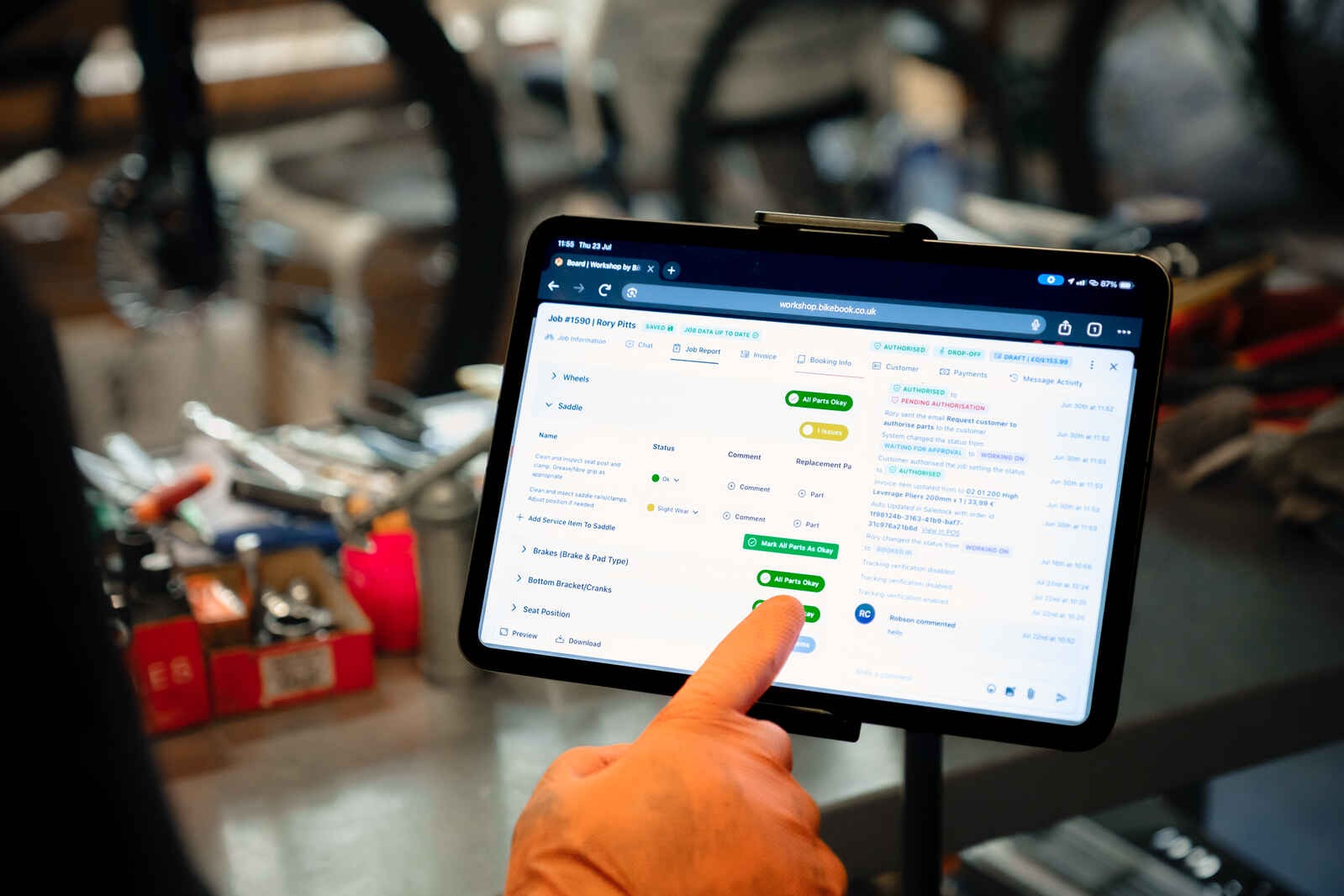
Running multiple bike shop locations means your workshop scheduling, stock control, and customer communication need to work as one system. When they don't, you lose time chasing mismatched records, missed bookings, and parts that are showing "in stock" at the wrong branch.
Bike shop management software built for service-led retailers solves that problem by connecting every job, every part, and every customer update across all your sites.
This guide compares six platforms that handle workshop scheduling and inventory control for multi-location bike retailers. You'll find a clear breakdown of what each one does well, where it falls short, and which one fits the way your workshop actually operates.
Workshop by Bikebook gives you a workshop-first workflow designed specifically for the cycling trade, with job tracking, stock management, and customer messaging built into one connected platform. The other five options approach the problem from different angles: some lean retail, some lean service, and one sits somewhere in between.
Quick guide: 6 best bike shop software for multi-location retailers
- Workshop by Bikebook: The best workshop management platform for service-led multi-location bike retailers
- Lightspeed Retail: Retail POS with vendor catalogues and service orders for shops that prioritise counter sales
- Hubtiger: Online repair booking and job tracking for workshops that need customer-facing scheduling
- Citrus-Lime: Cycle-specific EPOS with a native workshop calendar module for UK and US bike retailers
- Ascend RMS: Trek-affiliated retail management with work orders and multi-store inventory transfers
- Bikedesk: Combined EPOS, repairs, and webshop platform for European bike shops
How we chose the best bike shop software for multi-location retailers
Picking the right software for a multi-site cycling operation is not the same as choosing a generic retail tool. You need something that understands how a busy workshop floor connects to the shop counter, the stockroom, and your other locations. Here's what we looked for.
- Workshop scheduling depth: Can mechanics see their day across all locations, and can your team manage bookings without overbooking bays or staff?
- Inventory control across sites: Does the system track parts used on repairs in real time and keep stock accurate across every branch?
- Retail-to-service workflow: When a customer buys a bike at the counter, can the first service booking happen in the same system without re-entering their details?
- Customer communication: Does the platform send automatic updates as jobs progress, so your team spends less time on the phone?
- Integrations with existing tools: Can you connect the software to your POS, accounting, ecommerce, and supplier systems without building workarounds?
- Multi-location reporting: Can an operations lead see performance, revenue, and capacity across all stores from one dashboard?
The 6 best bike shop software for multi-location retailers
1. Workshop by Bikebook: Best overall bike shop management software for multi-location retailers
Workshop by Bikebook connects your bookings, stock management, job tracking, customer messaging, and invoicing into one workflow built specifically for the cycling industry. Developed in close collaboration with Cytech-registered mechanics, Workshop understands how service departments actually run, from the first booking to the final invoice.
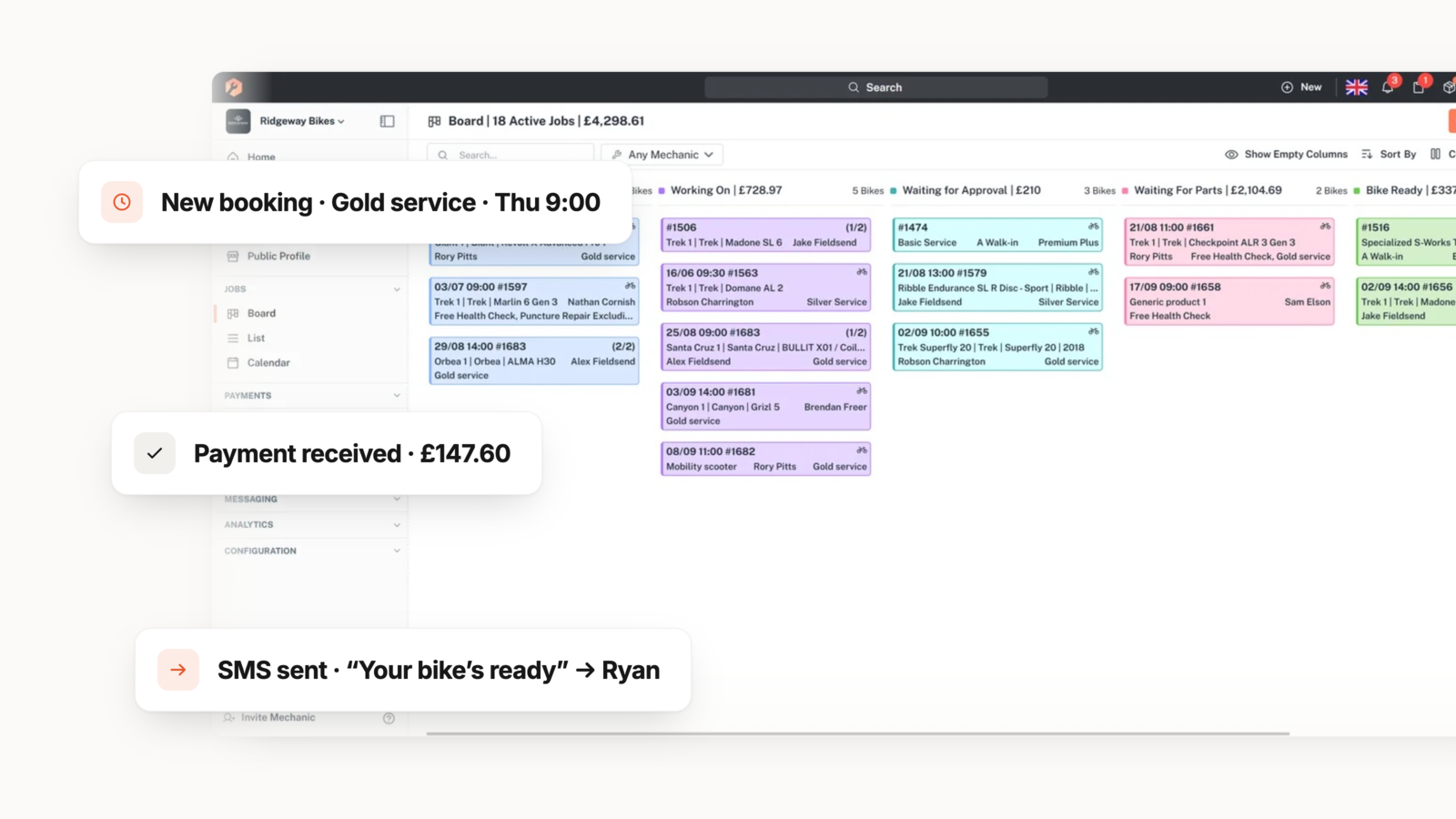
For multi-location retailers, Workshop by Bikebook brings every site into the same system. Your operations team gets a single view of job progress, capacity, and stock levels across branches. Mechanics work from digital job cards that keep service history, parts approvals, and customer details together. Customers receive automatic SMS and email updates as their job moves through your custom statuses, so your front desk handles fewer phone calls.
Workshop by Bikebook connects directly to Shopify, Lightspeed, Square, and Saledock on the POS side, plus Xero for accounting, Stripe, SumUp, and Zettle for payments, and 13 supplier catalogues including QBP, Madison, and Windwave for live stocklists. The Celerant partnership extends this to unified retail for multi-store operations, covering POS, ecommerce, and back office alongside Workshop's service management.
Workshop by Bikebook can save a mechanic up to 10 to 15 minutes on a major service, and the platform is designed to boost customer retention by up to 22%. Those numbers come from real workshop use, not marketing projections.
Workshop by Bikebook features
- Online and in-store booking management: Customers book directly from your website or Bikebook listing, and every appointment lands in the same calendar your team uses at the counter. Capacity controls prevent overbooking, and automatic reminders reduce no-shows.
- Digital job cards with service history: Every job tracks the bike, the customer, the mechanic, the parts used, and the service checklist. Service history carries forward, so your team has full context on repeat visits without digging through old paperwork.
- Automated customer messaging: SMS and email updates fire automatically as jobs move through your statuses. Customers confirm parts approvals in writing, and two-way chat keeps every conversation attached to the booking.
- Stock management tied to jobs: Parts applied to a job card update your stock count in real time. Low-stock alerts fire before you run out, and back orders raise directly from the job and stay linked until the part arrives.
- Supplier integrations: Search live stocklists from 13 connected suppliers without leaving the job card. Check availability and trade pricing, then raise an order in one step.
- Accounting sync with Xero: Invoices generate from completed jobs and push straight through to Xero, payments included. No re-keying, no reconciliation gaps at the end of the week.
Workshop by Bikebook pros and cons
Pros:
- Workshop-first workflow built around how bike service departments actually operate, not adapted from generic retail software
- Connects POS, ecommerce, payments, accounting, and 13 supplier catalogues in one platform
- Automated customer updates and two-way messaging reduce phone calls and keep approvals in writing
Cons:
- QuickBooks integration is on the roadmap but not yet available; Xero is the only accounting connection today
- WhatsApp messaging and a unified social inbox are currently in development
- Shops already embedded in a large retail ERP may need onboarding time to align existing processes with Workshop's workflow
2. Lightspeed Retail: Retail POS with service orders for inventory-led bike shops
Lightspeed Retail offers a retail-first POS with built-in service orders, vendor catalogue integrations, and multi-location inventory management. The platform handles serialised inventory tracking, purchase orders, and ecommerce from one system. Multi-store operators can use consolidated reporting, transfer orders, and per-location pricing controls.
The service order module lets you log repairs, assign statuses, and schedule jobs up to 14 days ahead. Staff can leave detailed notes and track progress. That said, workshop scheduling depth is limited compared to platforms built around service workflows, and mechanic workload management or capacity planning requires external tools or disciplined configuration.
Lightspeed Retail features
- Serialised inventory with vendor catalogues: Track bike frames and parts by serial number, receive shipments using integrated supplier catalogues, and manage matrix SKUs across size and colour variants.
- Service order management: Create work orders, assign statuses, and schedule services from within the POS. Seven configurable service statuses help track job progress.
- Multi-location reporting: Consolidated reporting, inter-store transfers, and per-location promotional controls let you manage multiple branches from one account.
Lightspeed Retail pros and cons
Pros:
- Inventory management depth is well-suited to bike shops with complex, high-volume parts catalogues
- Ecommerce and accounting integrations reduce manual reconciliation across sales channels
- Multi-location controls support consolidated reporting and inter-store stock transfers
Cons:
- Workshop scheduling and mechanic workload planning are not native features; they require third-party tools
- Repair stage configuration is limited by available fields, which can restrict granular job tracking
- Labour-rate catalogue rules require careful setup to keep repair estimates consistent across staff
3. Hubtiger: Online repair booking for customer-facing workshop scheduling
Hubtiger focuses on repair booking and customer communication. The platform handles online scheduling, digital job cards, automated notifications via email, SMS, or WhatsApp, and repair quoting with one-click customer approval.
Hubtiger integrates with several POS systems and pulls parts and labour pricing from your existing setup. The platform is used by over 2,000 repair businesses. For multi-location retailers, the focus remains on service workflow rather than full retail management, so you will need a separate POS and inventory system alongside it.
Hubtiger features
- Online repair scheduling: Customers book through your website, and details land directly in your calendar with a digital job card attached.
- Automated notifications: Customisable status-triggered updates go out by email, SMS, or WhatsApp at every repair stage you define.
- Productivity tracking: Log time against repairs and compare actual work to estimates, so your pricing reflects the real effort involved.
Hubtiger pros and cons
Pros:
- Customer-facing booking and communication tools are well-developed and reduce phone calls
- Two-way messaging keeps every customer conversation attached to the job it belongs to
- POS integrations pull pricing and parts data from your existing system
Cons:
- Does not include its own POS, inventory management, or ecommerce tools; you need separate systems for those
- Multi-location management features are not as developed as full-stack retail platforms
- Inventory and stock control rely entirely on your connected POS, not on Hubtiger itself
4. Citrus-Lime: Cycle-specific EPOS with a native workshop calendar
Citrus-Lime Cloud POS is an EPOS platform built for cycle retailers in the UK and US, with a native workshop module inside the same system as your sales floor. The workshop calendar handles job booking, mechanic assignment, parts logging, and status tracking. When a mechanic scans a part into a job, your inventory updates straight away.
The platform also covers ecommerce, loyalty, and supplier management for multi-store operators. Citrus-Lime recently launched an updated Workshop Module with a board view that shows every job by status, including value totals per column.
Citrus-Lime features
- Native workshop calendar: Book jobs, assign mechanics, and track status within the same system that runs your shop floor. Parts used on jobs reduce stock levels instantly.
- Board view for job visibility: A drag-and-drop board shows every job by status, with value totals per column for clearer commercial control.
- Integrated ecommerce and stock: Online and in-store sales share the same stock pool, so availability stays accurate across channels.
Citrus-Lime pros and cons
Pros:
- Workshop module is native to the EPOS, so parts used in repairs update stock without separate integration
- Cycle-specific supplier and catalogue management built into the platform
- Multi-store support connects retail and workshop under one system
Cons:
- Customer-facing online booking for workshops is not as developed as platforms focused on that workflow
- Automated customer messaging and approval workflows are more limited than service-first tools
- Depth of workshop scheduling (mechanic capacity planning, bay management) is secondary to the retail POS focus
5. Ascend RMS: Trek-affiliated retail management with work orders
Ascend RMS is a retail management platform built for bicycle and outdoor sports dealers, with a close affiliation to Trek. The system covers POS, inventory management with vendor catalogue support, work order lifecycle management, and multi-store operations including stock transfers and remote product lookup.
For multi-location operations, Ascend provides centralised reporting and the ability to manage inventory, pricing, and purchase orders across branches. Work orders link technician labour, estimates, and status notifications to the same job record. The platform is used primarily by Trek-affiliated dealers, and its integration ecosystem centres on that network.
Ascend RMS features
- Work order lifecycle: Service intake, estimates, technician labour tracking, and status updates stay linked to one job record throughout the repair.
- Multi-store inventory: Transfer stock between locations, manage per-store pricing, and view consolidated inventory reports from a central account.
- Vendor catalogue integration: Import supplier data to keep product information current and simplify receiving workflows.
Ascend RMS pros and cons
Pros:
- Work order system links intake, estimates, labour, and completion in a single timeline
- Multi-store inventory management supports transfers and centralised reporting
- Serialised item tracking supports assembly and warranty claims per unit
Cons:
- Primarily designed for Trek-affiliated dealers, which may limit relevance for non-Trek shops
- Complex variant and catalogue setups can slow initial onboarding for new product lines
- Advanced scheduling and service capacity rules require careful configuration
6. Bikedesk: Combined EPOS, repairs, and webshop for European bike shops
Bikedesk is a Danish-built bike shop management platform covering point of sale, repair management, inventory, online bookings, customer communication, and a webshop module. The system automates the repair flow from booking to pickup, including service reminders and follow-up messaging. Over 6,000 bike shop staff have used the platform since its launch.
Bikedesk handles job-to-parts traceability, appointment scheduling, and customer service history across repeat visits. The platform is popular across European markets, with UK support available. For multi-location operations, the system covers core needs but its cross-store automation is not as developed as platforms built specifically for multi-site retail groups.
Bikedesk features
- Automated repair flow: Jobs move from booking through to pickup with automated reminders and follow-up messaging at each stage.
- Online booking: Customers schedule repairs through your website, and every detail lands in your system without phone calls or manual entry.
- Integrated webshop: Sell online with synchronised stock levels, so in-store and web sales draw from the same inventory pool.
Bikedesk pros and cons
Pros:
- End-to-end repair workflow covers booking, job tracking, reminders, and follow-up in one system
- Webshop module keeps online and in-store inventory synchronised
- Service history stays connected to customer records across repeat visits
Cons:
- Ecommerce and accounting integrations are not as wide-ranging as some retail-first platforms
- Cross-store automation and multi-location reporting are more limited for larger groups
- Inventory setup requires more structured data entry than some operators expect at the start
How do you evaluate bike shop software for a multi-location workshop operation?
The first question to answer is whether your service department drives revenue independently or operates as a support function for retail sales. If workshop revenue is a standalone profit centre, you need software that treats service as the primary workflow, not as an add-on to a POS system.
Multi-location operators should test how inventory data flows between stores and the workshop. When a mechanic fits a part at one branch, does the stock count update across the whole group? According to a 2026 survey of 400 operators by inFlow, 84.8% of businesses still rely on spreadsheets to track inventory, even at companies with 500 or more employees. That number points to a real gap in how existing tools handle stock visibility across sites.
Look at how each platform handles workshop capacity. Can you see how many bays or mechanics are available per location, per day? Capacity planning is where many generic retail systems fall short, because they were not built around service throughput.
What makes workshop scheduling different from standard service order management?
Standard service order management records what needs doing. Workshop scheduling controls when it gets done, by whom, and how much capacity your team has left. The difference matters when you run multiple locations with varying mechanic availability and different service mixes.
A proper workshop scheduling tool shows your team the day ahead: which bikes are booked in, what work is assigned, which bays are free, and what parts are needed. It prevents overbooking by enforcing capacity limits per day and per service type. Workshop by Bikebook handles this with a combined calendar for online and walk-in bookings, custom statuses that match your own stages, and duration controls per job type.
If you are comparing platforms, ask whether the scheduling connects to stock. When a booking comes in for a groupset upgrade, the system should flag whether the parts are in stock at that branch, not leave your mechanic to discover the gap at 7am on a Monday.
Why Workshop by Bikebook is the best bike shop management software for multi-location retailers
Most platforms on this list started as retail POS systems and added workshop tools later. Workshop by Bikebook started at the service stand and built outward. That difference shows in how the platform connects booking management, job tracking, parts approvals, invoicing, and customer communication into a single workflow that follows how a repair job actually moves through your department.
For multi-location bike retailers, Workshop by Bikebook provides the operational visibility that generic tools cannot. Your operations lead can track job progress, revenue, and capacity across every branch from one dashboard. Your mechanics work from digital job cards with full service history, and your customers stay informed without your team picking up the phone. Workshop by Bikebook connects to your existing POS, accounting, payments, and supplier systems so you do not have to replace what already works on the retail floor.
Workshop by Bikebook is a partner for your business. Built specifically for the cycling industry and developed alongside Cytech-registered mechanics, it handles the service side so your team can spend less time on boring admin tasks and more time doing what they do well: keeping bikes on the road. Start your 28-day free trial and see how it fits your operation.
FAQs about bike shop management software for multi-location retailers
What is bike shop management software?
Bike shop management software handles the operational side of running a cycling business: bookings, job tracking, stock control, invoicing, customer communication, and reporting. Workshop by Bikebook brings all of these into one workflow designed specifically for bike workshops and service departments.
Can bike shop software handle both retail and workshop operations?
Some platforms cover both. Workshop by Bikebook manages the service side and connects to your existing POS, ecommerce, and accounting tools so retail and workshop data stay on the same customer record. Platforms that try to do everything in one system can lack depth in workshop-specific features.
How does inventory sync work across multiple bike shop locations?
With Workshop by Bikebook, parts applied to a job card update stock levels in real time. Connected supplier integrations let your team check availability and raise back orders from the job itself, across all branches. POS integrations keep retail and service stock aligned.
Is workshop scheduling included in bike shop POS systems?
Not always. Many POS systems include basic service order management but lack dedicated workshop scheduling with capacity controls, bay management, and mechanic assignment. Workshop by Bikebook provides a full booking calendar with online and in-store scheduling, capacity limits, and automatic reminders.
What integrations should I look for in bike shop software?
At a minimum, look for POS, accounting, payments, and supplier connections. Workshop by Bikebook integrates with Shopify, Lightspeed, Square, Saledock, Xero, Stripe, SumUp, Zettle, and 13 supplier catalogues. The Square partnership extends payment and catalogue sync to multi-site operations.


'%3e%3cg id='Final-Copy-2_2_' transform='translate(1275.000000, 200.000000)'%3e%3cpath class='st0' d='M7.4,12.8h6.8l3.1-11.6H7.4C4.2,1.2,1.6,3.8,1.6,7S4.2,12.8,7.4,12.8z'/%3e%3c/g%3e%3c/g%3e%3c/g%3e%3cg id='final---dec.11-2020'%3e%3cg id='_x30_208-our-toggle' transform='translate(-1275.000000, -200.000000)'%3e%3cg id='Final-Copy-2' transform='translate(1275.000000, 200.000000)'%3e%3cpath class='st1' d='M22.6,0H7.4c-3.9,0-7,3.1-7,7s3.1,7,7,7h15.2c3.9,0,7-3.1,7-7S26.4,0,22.6,0z M1.6,7c0-3.2,2.6-5.8,5.8-5.8 h9.9l-3.1,11.6H7.4C4.2,12.8,1.6,10.2,1.6,7z'/%3e%3cpath id='x' class='st2' d='M24.6,4c0.2,0.2,0.2,0.6,0,0.8l0,0L22.5,7l2.2,2.2c0.2,0.2,0.2,0.6,0,0.8c-0.2,0.2-0.6,0.2-0.8,0 l0,0l-2.2-2.2L19.5,10c-0.2,0.2-0.6,0.2-0.8,0c-0.2-0.2-0.2-0.6,0-0.8l0,0L20.8,7l-2.2-2.2c-0.2-0.2-0.2-0.6,0-0.8 c0.2-0.2,0.6-0.2,0.8,0l0,0l2.2,2.2L23.8,4C24,3.8,24.4,3.8,24.6,4z'/%3e%3cpath id='y' class='st3' d='M12.7,4.1c0.2,0.2,0.3,0.6,0.1,0.8l0,0L8.6,9.8C8.5,9.9,8.4,10,8.3,10c-0.2,0.1-0.5,0.1-0.7-0.1l0,0 L5.4,7.7c-0.2-0.2-0.2-0.6,0-0.8c0.2-0.2,0.6-0.2,0.8,0l0,0L8,8.6l3.8-4.5C12,3.9,12.4,3.9,12.7,4.1z'/%3e%3c/g%3e%3c/g%3e%3c/g%3e%3c/g%3e%3c/svg%3e) Your Privacy Choices
Your Privacy Choices